
Our Maths vision
The vision for maths at Callington Primary School is simple: everyone can achieve. Anyone who teaches maths does so with the expertise and knowledge to provide pupils with a deep understanding of key mathematical concepts and skills which enable all pupils to become high quality leaners through adaptive teaching. We want to be experts so that we can deliver with expertise.
Callinton Primary School want our pupils to become independent, resilient and active learners. We continually strive to empower our pupils to think mathematically through trying new experiences and learning from these. We want our children to question, to make connections and most importantly, to be excited by maths.
At Callington Primary School we are driving towards a love and understanding of Mathematics. We want children to recognise that mathematics is a beautiful subject; as such it has its own unique place in the curriculum at Callington.
We aim to provide pupils with powerful ways to describe, analyse and solve problems. The key intentions of Callington’s Mastery Curriculum are that pupils experience a sense of awe and wonder as they ‘experience’ mathematics, ‘discover’ more elegant solutions and ‘make links’ between different areas of mathematics.
At Callington we believe that:
-
the basic skills of mathematics are vital for the life opportunities of our children
-
mathematics develops the mind and those highly valued cognitive skills
-
every child should see themselves as a mathematician
As such we intend to:
-
foster positive attitudes, fascination and excitement of discovery through the teaching and learning of mathematical concepts
-
develop a ‘can do’ attitude in our children by demonstrating a confident attitude towards tackling problems both in and out of the classroom
-
broaden children’s knowledge and understanding of how mathematics is used in the wider world
-
enable our pupils to use and understand mathematical language and recognise its importance as a language for communication and thinking
At Callington, we have a very secure understanding of what ‘mastery’ is and how it looks in our lessons, books and ultimately in the children themselves. The three aims of the National Curriculum are addressed every day (not just in the maths lesson):
Fluency – Reasoning – Problem Solving.
By placing opportunities for rapid recall of number facts, calculation, reasoning and problem solving in to series of lessons, we ensure that secure links are made and that prior knowledge is being tested and challenged throughout. This allows our learners to develop a deep and lasting understanding of maths.
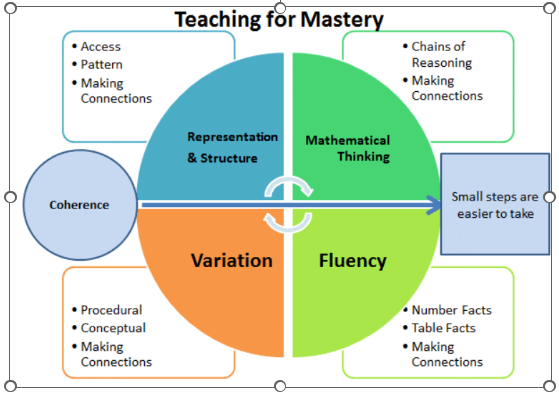
Through continuous, reflective training the teachers continue to improve their understanding and implementation of the NCETM's 5 Big Ideas. A true understanding of these ideas will probably best come about after discussion with Callington’s teachers and by exploring how the ideas are reflected in day-to-day maths teaching but here’s a flavour of what lies behind them:
Coherence
Teaching is designed to enable a coherent learning progression through the curriculum, providing access for all pupils to develop a deep and connected understanding of mathematics that they can apply in a range of contexts.
Representation and Structure
Teachers carefully select representations of mathematics to expose mathematical structure. The intention is to support pupils in ‘seeing’ the mathematics, rather than using the representation as a tool to ‘do’ the mathematics. These representations become mental images that students can use to think about mathematics, supporting them to achieve a deep understanding of mathematical structures and connections.
Mathematical Thinking
Mathematical thinking is central to how pupils learn mathematics and includes looking for patterns and relationships, making connections, conjecturing, reasoning, and generalising. Pupils should actively engage in mathematical thinking in all lessons, communicating their ideas using precise mathematical language.
Fluency
Efficient, accurate recall of key number facts and procedures is essential for fluency, freeing pupils’ minds to think deeply about concepts and problems, but fluency demands more than this. It requires pupils to have the flexibility to move between different contexts and representations of mathematics, to recognise relationships and make connections, and to choose appropriate methods and strategies to solve problems.
Variation
The purpose of variation is to draw closer attention to a key feature of a mathematical concept or structure through varying some elements while keeping others constant.
-
Conceptual variation involves varying how a concept is represented to draw attention to critical features. Often more than one representation is required to look at the concept from different perspectives and gain comprehensive knowledge.
-
Procedural variation considers how the student will ‘proceed’ through a learning sequence. Purposeful changes are made in order that pupils’ attention is drawn to key features of the mathematics, scaffolding students’ thinking to enable them to reason logically and make connections.
Number Fluency: Mastering Number (Reception and KS1 + Year 3)
Callington Primary School is involved with the Mastering Number Programme. Mastering Number is being used to secure firm foundations in the development of good number sense for all Callington children from Reception through to Year 1, Year 2 and Year 3. Children will leave KS1 with fluency in calculation and a confidence and flexibility with number; they will then embed this in Year 3.
We provide a daily teaching session of arithmetic for all children in KS2 of 10 to 15 minutes, in addition to their normal maths lesson.
Learning Facts + Times Tables
Memorisation and repetition of key facts (times tables and number bonds etc.) are important aspects of learning. Evidence from cognitive science research suggests that learning key facts so they can be recalled automatically ‘frees up’ working memory. It can then focus on more complex problem solving, rather than reaching cognitive overload trying to calculate simple operations. In terms of procedural fluency and conceptual understanding, one should not be prioritised over the other. Learning is most effective when the two are fully integrated.
Explicit teaching of times tables is taught through Funkey Tables; a mastery card game approach to teaching multiplication and division developing mathematical reasoning skills. The colour coding helps children develop rapid recall of facts. Each times tables has its own colour and pattern. For example, if a product is in the 7x table, there will be orange on the card. Pupils do not learn facts in isolation; they learn related facts together. This helps support conceptual understanding but also reduces the burden of learning times tables facts. Research shows the power of games-based learning for children where play provides a safe, fun, sociable space to learn. There are twelve games to play with the Funkey Times Table cards.
Whole Class Teaching
Mastery is characterised by a belief that, by working hard, all children are capable of succeeding at mathematics. On this basis children are taught all together as a class and are not split into ‘prior attainment’ groupings. At Callington, we use resources from the Oak Academy alongside the PD materials from the NCETM to support our teaching; the teachers at Callington understand that the component thought to be key to the success of mastery is the use of variation theory. Variation theory has several dimensions, including use of multiple representations of what a concept is, and what it is not. It is characterised by a carefully constructed small-step journey through learning. It pays attention to what is kept the same and what changes, in order that pupils might reason. This means that they will make connections and build deep conceptual knowledge.
Understanding Structures
A focus on exposing the structure of mathematics and developing an understanding of how and why maths works is crucial to mastery. A key skill of the teacher is to be able to represent the maths in ways that provide access and insight for pupils.
Concrete materials, contexts, drawings, diagrams and equations all play a role. These are discussed through opportunities for pupil-pupil and pupil-teacher talk, to develop reasoning, flexibility and adaptability in mathematical thinking.
Mathematical Language
Teaching children precise mathematical language and insisting upon its use supports children's ability to think mathematically. Having the language and using it empowers children’s ability to think about the concept.